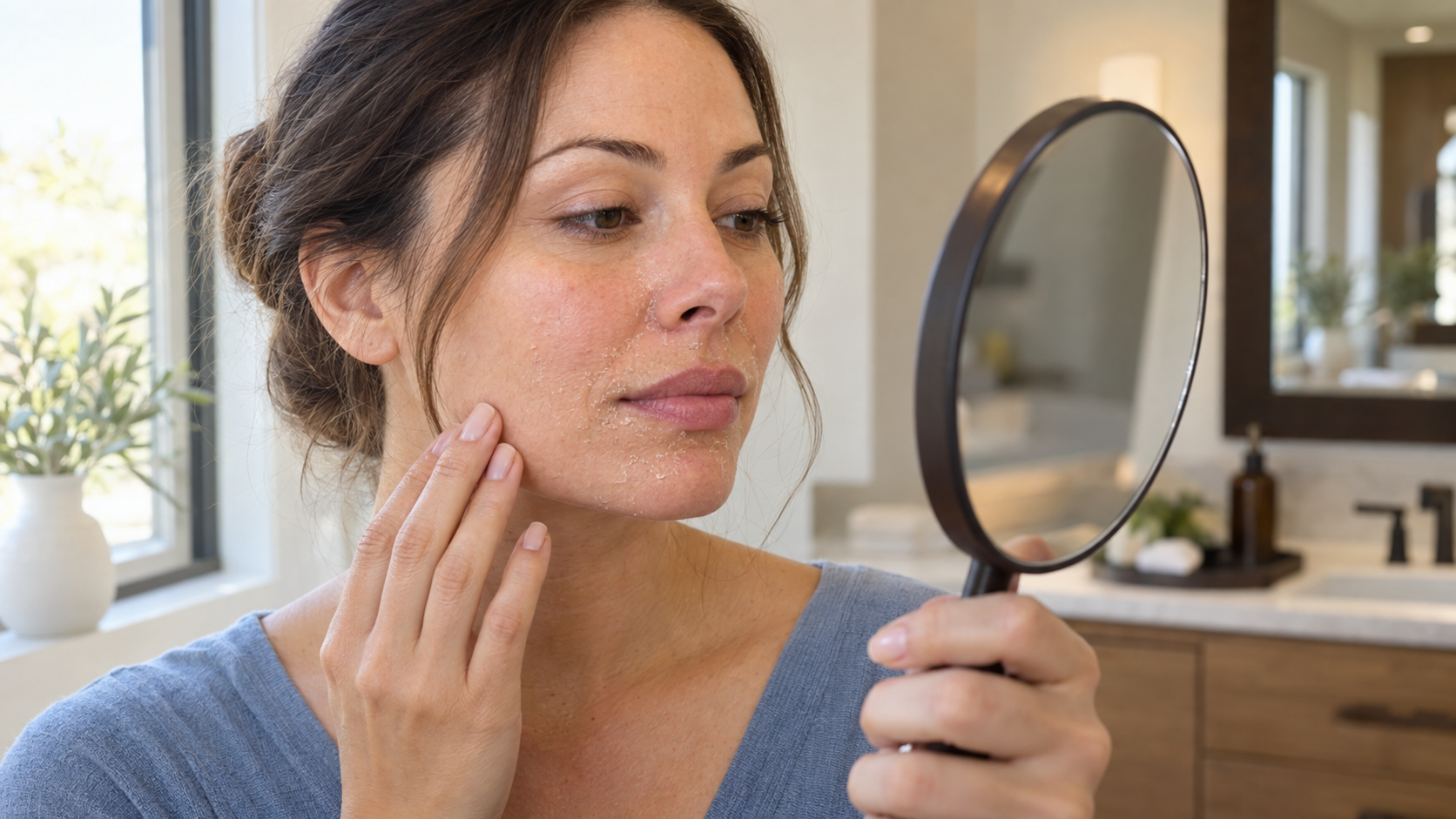
A dermal filler can look excellent when your face is relaxed, but what happens when you smile, laugh, speak, or raise your eyebrows? Because the face is constantly moving, natural-looking injectable results depend on more than simply restoring volume. Product characteristics, placement, treatment area, facial anatomy, and injector technique all influence how an enhancement behaves during expression.
That makes RHA fillers vs Juvederm an important comparison for people who prioritize results that look natural both at rest and in motion. Both are hyaluronic acid filler families, but each collection contains products with different characteristics designed for different aesthetic objectives.
There is also no universal winner. AlluraDerm’s current approach reflects this distinction: its dermal filler treatments include multiple filler collections so the injector can select a product according to movement, desired softness or structure, anatomy, and treatment goals rather than forcing one filler into every situation.
Jump To:
- TLDR Quick Guide
- Understanding the RHA Filler Collection
- Understanding the JUVÉDERM Collection
- RHA Fillers vs JUVÉDERM During Facial Movement
- Why Filler Flexibility Matters
- How Different RHA Products Affect the Comparison
- Which Filler Is Better for Smile Lines?
- Which Is Better for Lips and Perioral Movement?
- What About Cheeks, Chin, and Jawline?
- Why Injector Technique Can Matter More Than Brand
- How to Choose Between RHA and JUVÉDERM
- What to Expect After Treatment
- Key Takeaways
- Frequently Asked Questions
TLDR Quick Guide
- Both RHA and JUVÉDERM include hyaluronic acid dermal fillers.
- RHA products are designed with dynamic facial movement as an important consideration.
- JUVÉDERM is a collection rather than a single filler, with formulations suited to different areas and levels of structural support.
- A more flexible filler is not automatically more natural for every treatment area.
- Areas that move frequently may require different properties than areas requiring projection or structural definition.
- Product selection should account for facial anatomy, movement, placement, and aesthetic goals.
- Injector technique can matter just as much as the filler brand.
- The best comparison is specific product versus specific product—not simply RHA versus JUVÉDERM.
Understanding the RHA Filler Collection
Why RHA Is Associated With Dynamic Facial Areas
RHA stands for Resilient Hyaluronic Acid. The collection was developed with facial dynamics in mind, which is one reason patients researching subtle injectable results frequently encounter RHA when asking about fillers for areas that move during expression.
That does not mean every RHA product has the same consistency or should be placed in the same location. The collection includes different formulations so an injector can match the product to the depth of the concern and the degree of support required.
The practical advantage is customization. Rather than thinking of RHA as one filler, patients should think of it as a family of options with different roles.
RHA 2 for More Refined Correction
When an area needs subtle correction and flexibility, a softer formulation may be preferable to a highly structural product.
This is where RHA 2 may enter the conversation. The decision still depends on individual anatomy, tissue characteristics, the location being treated, and the desired outcome.
A lighter treatment philosophy can be particularly important when the objective is refinement rather than dramatic volume.
Understanding the JUVÉDERM Collection
JUVÉDERM Is Not One Type of Filler
Comparisons between RHA and JUVÉDERM can become misleading when JUVÉDERM is treated as if it were one uniform product.
The JUVÉDERM collection contains formulations intended for different purposes. AlluraDerm’s current filler information emphasizes that product characteristics vary and that fillers can be selected according to the amount of softness, flexibility, volume, or structural support required.
For example, a product selected to enhance a lip does not necessarily need the same physical characteristics as one selected to define a jawline.
Some JUVÉDERM Products Are Designed for Flexible Correction
JUVÉDERM should not automatically be characterized as the “firmer” alternative to RHA.
JUVÉDERM Vollure XC, for example, is used for lower-face correction and is described by AlluraDerm as providing support without excessive bulk, allowing the injector to create gently restored contours.
Other members of the collection are intended for more structural applications. JUVÉDERM Volux XC, for instance, is specifically formulated to provide firmness and structural support for jawline definition.
The better question is therefore not simply, “Which brand moves better?” It is, “Which formulation has the appropriate properties for this particular part of my face?”
RHA Fillers vs JUVÉDERM During Facial Movement
RHA Places Particular Emphasis on Dynamic Expression
Areas around the mouth and lower face are rarely stationary. Smiling, talking, eating, laughing, and other expressions repeatedly compress and stretch the tissue.
For these dynamic areas, an injector may consider how well the selected filler accommodates movement in addition to how much volume it provides. This is one reason RHA is frequently discussed when maintaining expressive movement is a high priority.
However, natural movement still depends on appropriate placement and quantity. Even a flexible product can look unnatural if it is poorly selected or overused.
JUVÉDERM Can Also Produce Natural-Looking Movement
It would be inaccurate to conclude that JUVÉDERM inherently looks stiff.
The collection includes products with different physical characteristics, allowing injectors to choose according to the treatment area. AlluraDerm specifically describes its filler strategy as matching products to desired structure or softness while aiming for balanced, natural-looking enhancement.
The injector’s understanding of the patient’s expressions is therefore critical. A good assessment should consider what the face looks like while moving—not just a static photograph.
Why Filler Flexibility Matters
Your Face Is a Moving Structure
Facial expressions involve multiple layers of skin, fat, connective tissue, and muscle moving together.
If filler is placed in a highly expressive area, the product becomes part of that moving environment. The treatment therefore needs to account for how the surrounding tissues behave when the patient smiles or speaks.
This is especially relevant around the mouth, where subtle changes can have a noticeable effect on expression.
Flexibility Is Only One Part of Natural Results
It is tempting to assume that the most flexible filler must produce the most natural result. That is not necessarily true.
Some areas benefit from stronger structural support. The jawline, chin, or certain areas of facial volume loss may need enough projection and stability to create a visible improvement.
A filler that is ideal for a highly dynamic line may not provide enough support for facial contouring. Natural-looking treatment comes from matching the material to the job.
How Different RHA Products Affect the Comparison
RHA 3 Can Address Different Needs Than RHA 2
Moving further through the RHA collection illustrates why comparing brands alone is insufficient.
A formulation such as RHA 3 may be considered when an injector needs a different balance of correction and flexibility than a lighter formulation provides.
The treatment decision should still be based on the patient’s anatomy and the specific concern rather than assuming a higher product number is automatically better.
RHA 4 Moves Toward Greater Support
Some patients need more substantial correction while still wanting a natural-looking result.
That is where a more supportive product within the RHA family may be considered. The existence of multiple formulations demonstrates an important principle: even a filler collection known for dynamic treatment requires different properties for different facial needs.
This reinforces why RHA fillers vs Juvederm cannot be reduced to “flexible versus firm.”
Which Filler Is Better for Smile Lines?
Movement and Fold Depth Both Matter
Nasolabial folds are particularly interesting because they combine facial movement with structural changes.
A mild fold and a deep fold do not necessarily require the same product. An injector must consider the depth of the crease, surrounding volume, tissue quality, facial movement, and whether correcting another area could improve the fold indirectly.
Hyaluronic acid fillers, including products within major filler families, can be used to soften facial folds when clinically appropriate.
Completely Erasing a Fold Is Not Always the Goal
Natural faces have folds.
Attempting to remove every crease can require excessive product and potentially interfere with normal facial proportions. A more refined objective is often to soften the fold while maintaining natural transitions during expression.
That philosophy applies regardless of whether RHA or JUVÉDERM is selected.
Which Is Better for Lips and Perioral Movement?
The Mouth Requires Especially Careful Product Selection
Few areas move more frequently than the lips.
They stretch, compress, purse, smile, speak, and interact with surrounding tissues throughout the day. A filler placed here needs to complement both the patient’s anatomy and the intended aesthetic outcome.
Someone seeking subtle lip restoration may need a very different product and injection pattern from someone seeking greater shape or projection.
JUVÉDERM Has Products Designed for Subtle Lip Enhancement
JUVÉDERM’s range includes products intended for lip and perioral applications. For example, AlluraDerm describes Volbella as a soft hyaluronic acid filler used for subtle lip enhancement and perioral lines while maintaining smooth, natural texture and movement.
This is another reason the claim that one entire brand always moves more naturally than another is too simplistic.
What About Cheeks, Chin, and Jawline?
Structural Areas Change the Equation
When the objective shifts from smoothing a dynamic line to building contour, flexibility may become less important than projection and support.
A jawline treatment, for example, may need a firmer product capable of creating definition. AlluraDerm’s JUVÉDERM Volux XC information specifically describes it as a structural hyaluronic acid filler for jawline definition and lower-face contour.
In this situation, selecting a very soft product simply because it moves easily would not necessarily create the desired outcome.
Natural Does Not Always Mean Soft
A natural-looking jawline should have structure. A natural-looking lip should move appropriately. A natural-looking cheek should transition smoothly into surrounding facial contours.
“Natural” therefore describes the final relationship between the filler and the patient’s anatomy—not one universal filler texture.
Why Injector Technique Can Matter More Than Brand
Correct Placement Changes How a Filler Behaves
Even an excellent filler can produce disappointing results when placed incorrectly.
Injection depth, volume, distribution, treatment area, and the patient’s underlying anatomy all affect the final appearance. AlluraDerm’s current approach begins with an assessment of facial proportions, movement, and volume distribution before selecting a filler.
That process is more meaningful than choosing a product based solely on online popularity.
Overfilling Can Make Either Collection Look Unnatural
Patients sometimes focus heavily on filler brands while overlooking the amount of product being used.
Too much volume can distort proportions regardless of the manufacturer’s technology. Conservative placement can often preserve recognizable facial characteristics more effectively than pursuing maximum correction.
The objective should be enough product to accomplish the treatment goal—not simply more filler.
How to Choose Between RHA and JUVÉDERM
Start With the Treatment Goal
Instead of entering a consultation asking for a brand, begin with the outcome you want.
Are you trying to soften lines while smiling? Restore lost cheek volume? Add subtle lip definition? Strengthen the jawline?
Each goal requires different filler behavior.
Let Facial Anatomy Guide the Product
Two people requesting the same treatment can have different facial structures, tissue thickness, movement patterns, and existing volume.
That means they may receive different recommendations even when their aesthetic goals sound similar.
A personalized assessment is the best way to determine which formulation makes sense. AlluraDerm offers multiple filler collections precisely because product selection can be tailored to the patient’s anatomy and desired balance between softness, movement, volume, and structure.
What to Expect After Treatment
Results Are Often Visible Quickly
Hyaluronic acid fillers generally create visible changes soon after injection. Temporary swelling, tenderness, redness, or bruising may initially affect how the result appears.
AlluraDerm notes that these common post-treatment effects generally improve as the filler settles and the contours become more refined.
Patients should therefore avoid judging movement and symmetry immediately after leaving the treatment room.
The Settled Result Matters More
Once temporary swelling decreases, it becomes easier to evaluate how the filler integrates with facial movement.
A successful result should look appropriate from multiple angles and during normal expressions—not only when the face is perfectly still.
Follow-up also gives the provider an opportunity to evaluate whether additional correction is appropriate.
Key Takeaways
- RHA fillers vs Juvederm is not a simple winner-versus-loser comparison.
- Both collections include hyaluronic acid fillers with different properties and applications.
- RHA is strongly associated with fillers designed around dynamic facial movement.
- JUVÉDERM includes both softer formulations and highly structural products.
- Highly expressive areas may require different filler properties than the cheeks, chin, or jawline.
- A flexible filler is not automatically the most natural choice for every facial area.
- Product quantity, injection depth, placement, anatomy, and injector technique significantly affect the outcome.
- The most natural-looking approach is generally the filler that best matches the patient’s anatomy, movement, and treatment goal.
Frequently Asked Questions
Do RHA fillers look more natural than JUVÉDERM when smiling?
RHA fillers are designed with dynamic facial movement as an important consideration, which can make them useful for certain expressive areas. However, JUVÉDERM also includes formulations that can produce soft, natural-looking results during movement. The better choice depends on the specific product, treatment area, anatomy, and injection technique.
Is RHA better than JUVÉDERM for smile lines?
Not automatically, because the depth and cause of smile lines differ between patients. An injector may consider flexibility, structural support, surrounding volume, and how the fold changes during expression before choosing a product. Both filler families may have appropriate options depending on the individual treatment plan.
Which filler is better for natural-looking lips?
The best lip filler depends on whether the goal is hydration, subtle definition, restored volume, or greater projection. Both product selection and conservative placement influence whether the lips look natural while speaking and smiling. An experienced injector should select a formulation based on the patient’s existing lip anatomy rather than brand preference alone.
Can RHA and JUVÉDERM be used in different areas of the same face?
Potentially, yes, because different facial areas can require different product characteristics. A provider may determine that one formulation is appropriate for a dynamic area while another offers better structural support elsewhere. Any combination should be based on an individualized treatment plan rather than routinely mixing products.
How do I decide between RHA fillers and JUVÉDERM?
Start by identifying what you want to change rather than choosing a filler brand first. A qualified injector can assess your facial anatomy, movement, volume distribution, and desired level of correction before recommending a specific formulation. This individualized approach is generally more useful than assuming one filler collection is universally more natural.