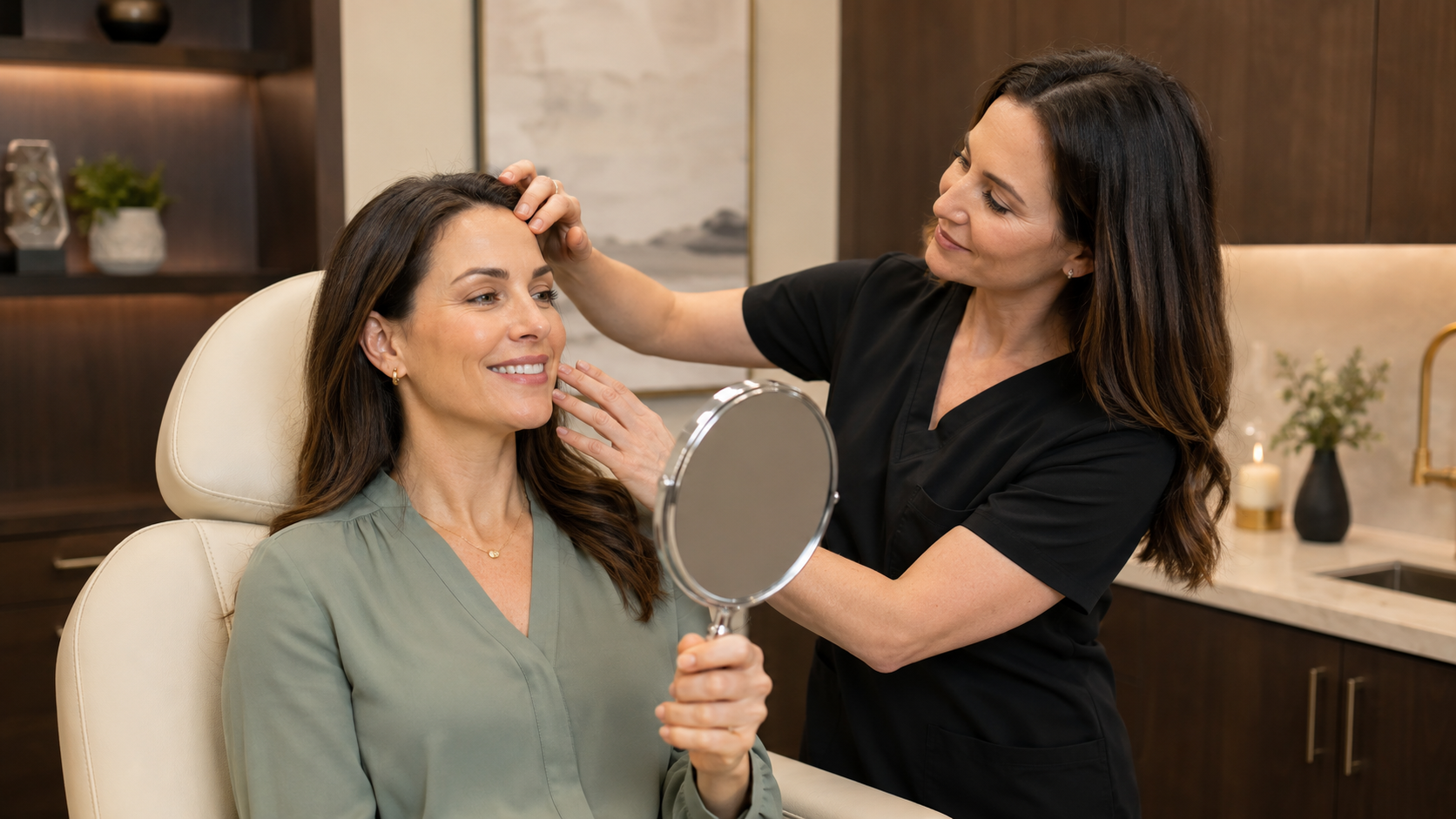
It is easy to assume that all hyaluronic acid injectables work similarly. In reality, choosing between SkinVive and traditional filler starts with identifying what you actually want to improve.
Someone bothered by dullness, roughness, or a lack of hydration may have very different needs from someone experiencing hollow cheeks, changing facial contours, or age-related volume loss. Treating both concerns with the same approach can lead to unnecessary volume or an outcome that doesn’t address the patient’s primary goal.
SkinVive by JUVÉDERM represents a different approach to injectable rejuvenation. Rather than primarily reshaping facial contours, it uses intradermal microdroplets of hyaluronic acid in the cheeks to improve skin smoothness.
Understanding the difference between SkinVive vs dermal fillers makes it easier to choose a treatment based on the result you want—not simply because both treatments happen to be injectables.
Jump To:
- TLDR Quick Guide
- What Is SkinVive?
- What Are Traditional Dermal Fillers?
- SkinVive vs Dermal Fillers: The Main Difference
- Which Is Better for Hydration and Skin Quality?
- Which Is Better for Facial Volume Loss?
- Can SkinVive Make Your Face Look Fuller?
- Can Dermal Filler Improve Skin Quality Too?
- SkinVive vs Dermal Fillers for Natural-Looking Results
- Can You Combine SkinVive and Dermal Fillers?
- Who May Prefer SkinVive?
- Who May Prefer Traditional Dermal Fillers?
- What About Dull or Dehydrated Skin?
- What Should You Expect From a Consultation?
- How to Choose Between SkinVive and Dermal Fillers
- Key Takeaways
- Frequently Asked Questions
TLDR Quick Guide
SkinVive vs Dermal Fillers at a Glance
SkinVive may make more sense when your priority is:
- Improving cheek skin smoothness
- Supporting a hydrated, refreshed appearance
- Improving skin quality without seeking significant volume
- Maintaining your existing facial proportions
- Achieving a subtle improvement rather than facial reshaping
Traditional dermal filler may make more sense when your priority is:
- Restoring lost facial volume
- Improving facial contours
- Enhancing cheeks, lips, chin, or jawline
- Correcting certain folds or wrinkles
- Creating additional structure or definition
Neither option is automatically “better.” The right choice depends on whether the underlying concern is primarily skin quality or facial structure.
What Is SkinVive?
An Injectable Designed Around Skin Smoothness
SkinVive is an injectable hyaluronic acid treatment designed to improve the smoothness of cheek skin.
Instead of placing filler primarily to create projection or replace deeper volume, SkinVive is administered as small intradermal injections. This approach makes skin quality the central objective.
That distinction is important for people who look in the mirror and think, “I don’t want my face to look fuller—I just want my skin to look better.”
Why Hyaluronic Acid Matters
Hyaluronic acid naturally binds water, which is one reason it is widely used in aesthetic treatments.
With SkinVive, the objective isn’t simply to place a larger pocket of volume underneath the skin. The treatment uses small amounts distributed throughout the treatment area to support smoother-looking cheek skin.
This can be particularly attractive to patients who want an injectable treatment but don’t want an obvious change in facial shape.
What Are Traditional Dermal Fillers?
Fillers Are Primarily Used to Address Shape and Volume
Traditional dermal filler treatments can accomplish a much broader range of structural goals.
Depending on the filler selected and where it is placed, treatment may help:
- Restore facial volume
- Enhance lip shape
- Improve cheek contours
- Define the chin or jawline
- Soften certain wrinkles or folds
- Improve facial proportions
Rather than asking whether filler improves skin, it is more useful to ask what anatomical change the filler is intended to create.
Different Fillers Serve Different Purposes
“Dermal filler” isn’t one single treatment.
Different formulations have different characteristics, including firmness, flexibility, lifting capacity, and suitability for particular treatment areas. An injector may therefore select a softer product for one area and a more structurally supportive option elsewhere.
This is why choosing a filler should follow a facial assessment rather than starting with a particular brand or syringe count.
SkinVive vs Dermal Fillers: The Main Difference
Skin Quality vs Facial Structure
The easiest way to understand SkinVive vs dermal fillers is to separate two different aesthetic goals.
SkinVive: primarily targets the quality and smoothness of cheek skin.
Dermal fillers: primarily address volume, contours, proportions, and certain wrinkles or folds.
Imagine someone whose cheeks have adequate volume but whose skin looks less smooth or refreshed than they would like. Adding conventional filler for projection may alter facial shape without directly matching the person’s goal.
Now consider someone with significant age-related cheek volume loss. Improving surface skin quality alone may not adequately address the structural change creating the concern.
The treatment should match the problem.
Which Is Better for Hydration and Skin Quality?
SkinVive Has the More Specific Skin-Quality Role
If your primary concern is improving cheek skin smoothness without significantly changing facial contours, SkinVive may be the more relevant treatment to discuss.
Patients often become interested in this category of treatment when their concerns include:
- Dull-looking skin
- Dehydrated appearance
- Rough-looking texture
- Reduced radiance
- Skin that looks tired despite a good skincare routine
SkinVive’s role is different from simply adding facial volume, which allows patients to pursue a refreshed appearance without necessarily seeking a fuller face.
Skin Quality Is More Than Hydration
It is also important not to treat every skin concern as dehydration.
Visible skin quality can be influenced by sun damage, pigmentation, acne scarring, laxity, enlarged pores, fine lines, and other factors. An injectable designed to improve smoothness may not be the best treatment for every one of those concerns.
For that reason, patients may benefit from combining or comparing injectable options with skincare, lasers, microneedling, chemical peels, or other treatments when appropriate.
Which Is Better for Facial Volume Loss?
Traditional Filler Has a Different Job
When the primary issue is facial volume loss, conventional filler generally has a more directly structural purpose.
Volume changes can create:
- Flattened or hollow-looking cheeks
- Deeper facial folds
- Reduced facial definition
- Changes in proportions
- A more tired appearance
Strategically placed filler can replace or enhance volume in targeted areas rather than simply focusing on the skin’s surface appearance.
Don’t Confuse Dehydration With Volume Loss
This distinction can be difficult to make on your own.
A face can appear tired because the skin lacks radiance, because structural volume has changed, or because both issues are occurring simultaneously. Treating dehydration as volume loss could result in unnecessary fullness, while treating meaningful structural changes solely as a skin-quality concern may leave the underlying issue unchanged.
A professional assessment helps determine which layer of the face actually needs attention.
Can SkinVive Make Your Face Look Fuller?
Significant Facial Reshaping Isn’t the Main Objective
Patients sometimes hear “hyaluronic acid injectable” and assume SkinVive will behave like cheek filler.
That isn’t the intended treatment concept.
SkinVive uses small intradermal injections rather than being selected primarily to create projection or reshape the cheeks. The goal is improvement in cheek skin smoothness rather than a dramatic increase in facial volume.
For patients who like their existing facial proportions, that distinction can be a major advantage.
Can Dermal Filler Improve Skin Quality Too?
Filler Can Improve Appearance Without Being a Skin-Quality Treatment
Dermal filler can certainly make the face look smoother or more refreshed when volume loss contributes to shadows, folds, or altered contours.
However, that doesn’t make traditional filler interchangeable with SkinVive.
If the problem is primarily structural, restoring appropriate support can improve the overall appearance. If the structure is already appropriate and surface quality is the primary concern, adding additional volume may not be the most logical solution.
The best result comes from understanding why the face looks the way it does before selecting the treatment.
SkinVive vs Dermal Fillers for Natural-Looking Results
Both Can Look Natural When Used for the Right Reason
Natural results aren’t determined by the treatment name alone.
They depend on:
- Appropriate patient selection
- Product selection
- Injection technique
- Treatment location
- Amount used
- Existing facial anatomy
- Realistic treatment goals
SkinVive can provide a subtle approach when the patient doesn’t want facial reshaping. Traditional filler can also look extremely natural when it restores or enhances proportions conservatively.
Problems are more likely to occur when a treatment is asked to accomplish something it wasn’t intended to do.
Can You Combine SkinVive and Dermal Fillers?
Skin and Structure Can Be Treated Separately
For some patients, the answer doesn’t have to be SkinVive or filler.
Someone may have both declining skin quality and facial volume changes. In that situation, one treatment could address structural support while another targets skin smoothness.
For example, filler might be strategically used where volume restoration is appropriate while SkinVive addresses cheek skin quality.
The key is that each treatment has a defined purpose rather than simply adding multiple injectables without a clear plan.
Who May Prefer SkinVive?
Patients Who Don’t Want More Facial Volume
SkinVive may be worth discussing if you:
- Like your existing facial shape
- Don’t want fuller cheeks
- Want subtle rejuvenation
- Are primarily concerned about cheek skin smoothness
- Prefer a treatment focused on skin quality
It may also appeal to patients who aren’t ready for more structural facial enhancement but want something beyond topical skincare.
That doesn’t mean everyone with dry or dull skin automatically needs SkinVive. The cause and extent of the concern should still be evaluated first.
Who May Prefer Traditional Dermal Fillers?
Patients Seeking Structural Changes
Traditional filler may be more appropriate if your goals include:
- Restoring lost cheek volume
- Enhancing lips
- Creating stronger chin definition
- Improving facial proportions
- Contouring the jawline
- Correcting certain facial folds
These are fundamentally different goals from improving cheek skin smoothness.
If you want visible changes in facial shape or support, SkinVive alone may not provide the type of correction you’re expecting.
What About Dull or Dehydrated Skin?
Look at the Whole Skin Picture
Patients concerned about dullness frequently focus on a single treatment, but healthy-looking skin is influenced by several factors.
Home skincare, sun protection, hydration, lifestyle, skin treatments, and age-related changes can all influence appearance. Injectable treatment should therefore fit within a broader strategy rather than replacing good skincare habits.
For someone whose primary complaint is dry or dehydrated skin, identifying what is causing the appearance is an important first step.
The best treatment plan may involve one modality—or several complementary approaches.
What Should You Expect From a Consultation?
Start With Your Concern, Not a Product Name
Instead of walking into a consultation saying, “I need SkinVive” or “I need two syringes of filler,” describe what you see and what you want changed.
For example:
“My skin looks dull even when I’m well rested.”
“My cheeks have lost their shape.”
“I want smoother skin, but I don’t want my face to look fuller.”
“My lower face looks heavier than it used to.”
These statements give the provider more useful information than selecting a product in advance.
Facial Assessment Determines the Better Option
A provider can evaluate:
- Facial proportions
- Existing volume
- Skin characteristics
- Areas of movement
- Wrinkle patterns
- Treatment history
- Desired level of correction
This allows the treatment plan to address the actual concern instead of simply using whichever injectable is currently popular.
How to Choose Between SkinVive and Dermal Fillers
Ask Yourself What You Want to Change
Before your consultation, look beyond the words “filler” and “skin booster.”
Ask:
Do I want my skin to look smoother, or do I want my facial shape to change?
If skin smoothness is the main priority, SkinVive may be worth discussing. If lost volume, contour, projection, or facial proportions are the primary issues, conventional dermal filler may be more appropriate.
If you aren’t sure, that’s precisely what an individualized assessment is designed to determine.
Key Takeaways
- SkinVive vs dermal fillers is primarily a comparison between improving skin quality and addressing facial structure.
- SkinVive is designed to improve cheek skin smoothness using intradermal hyaluronic acid microdroplets.
- Traditional dermal fillers are generally better suited to restoring volume, enhancing contours, and modifying facial proportions.
- SkinVive may appeal to patients who want refreshed-looking skin without significant facial reshaping.
- Traditional filler can still produce natural results when appropriately selected and conservatively placed.
- Patients can have both skin-quality concerns and structural volume loss, so SkinVive and filler don’t always have to be mutually exclusive.
- The best treatment should be based on anatomy and goals rather than choosing an injectable simply because it is popular.
Frequently Asked Questions
Is SkinVive better than dermal filler for skin quality?
SkinVive is specifically designed to improve the smoothness of cheek skin, making it particularly relevant when skin quality is the primary concern. Traditional fillers are generally selected when volume restoration, contouring, or structural enhancement is needed. The better option therefore depends on whether you want to improve the skin itself or change facial shape and support.
Does SkinVive add volume like regular filler?
SkinVive contains hyaluronic acid, but significant facial volumization isn’t its primary purpose. It is administered as small intradermal injections intended to improve cheek skin smoothness rather than create substantial projection. Patients seeking cheek enhancement or structural volume restoration may need a traditional dermal filler instead.
Can I get SkinVive and dermal filler together?
Some patients may benefit from both because the treatments can address different aesthetic concerns. Dermal filler might address structural volume while SkinVive focuses on cheek skin quality. Whether combining them is appropriate should be determined through an individualized assessment.
Is SkinVive good for dehydrated-looking skin?
SkinVive may be worth discussing when a patient wants smoother, more hydrated-looking cheek skin without substantial additional volume. However, dry or dull-looking skin can have multiple causes that may require skincare or other aesthetic treatments. A consultation can determine whether SkinVive addresses the specific concern effectively.
How do I know whether I need SkinVive or regular filler?
Consider whether your primary concern is skin smoothness or a loss of facial volume and definition. SkinVive may better match skin-quality goals, while traditional filler may be more appropriate for structural changes and contouring. A professional facial assessment can distinguish between these concerns and determine the most suitable treatment plan.