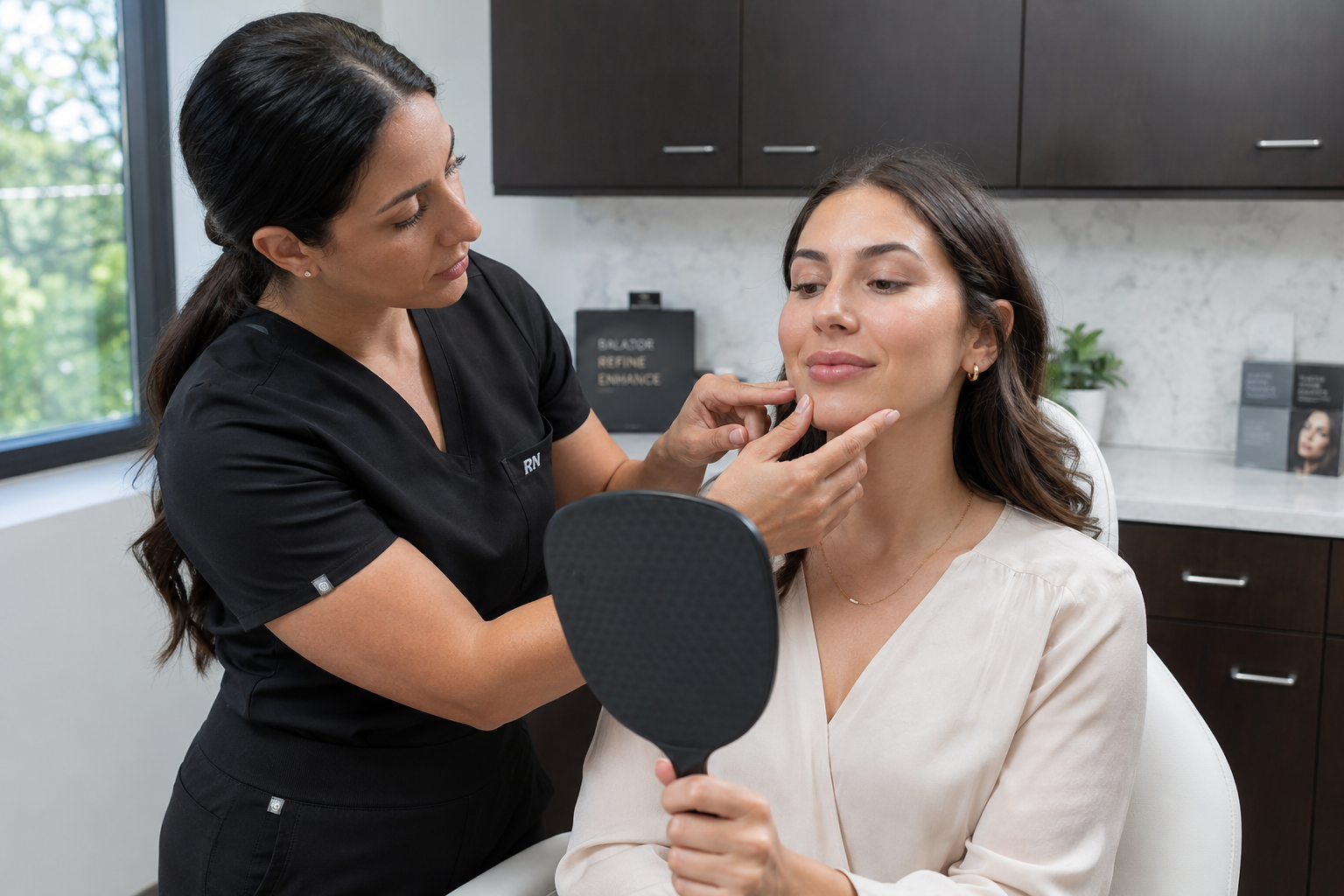
Dermal fillers have become one of the most effective tools in aesthetic medicine for facial contouring. Among the most popular options are Volux and Voluma, two fillers from the trusted Juvéderm collection. While both are designed to enhance facial shape and restore volume, each serves a unique purpose. Understanding their differences can help you choose the right option for jawline definition, cheek lift, or overall facial harmony.
Jump To:
TLDR – Quick Guide
- Volux is formulated for jawline sculpting and chin enhancement, offering firmness and strong structural support.
- Voluma is designed to lift and restore volume in the cheeks and midface for a youthful appearance.
- Both are hyaluronic acid (HA) fillers but differ in density and placement goals.
- Downtime is minimal for both treatments, with results lasting up to 18–24 months.
- Consultation with a qualified injector is key to selecting the right filler.
What Are Volux and Voluma?
Both Volux and Voluma are hyaluronic acid-based fillers using Vycross technology, which cross-links HA for longer-lasting results. However, their formulations are tailored for different contouring goals:
- Volux has a firmer, more cohesive structure, making it ideal for sculpting areas that need definition, such as the jawline and chin.
- Voluma has a softer yet lifting consistency, perfect for restoring fullness to cheeks and midface.
Key Differences Between Volux and Voluma
1. Purpose and Treatment Areas
- Volux: Jawline, chin, lower face definition.
- Voluma: Cheeks, midface, subtle lift.
2. Product Density
- Volux: Highest density among Juvéderm fillers, giving structure and sharp contours.
- Voluma: Medium density, designed for natural-looking volume and lift.
3. Longevity
- Volux: Results typically last up to 18–24 months, depending on metabolism and lifestyle.
- Voluma: Results often last around 12–18 months.
4. Candidate Suitability
- Volux: Ideal for adults seeking a defined jawline or correction of age-related sagging in the lower face.
- Voluma: Best for individuals experiencing midface volume loss or seeking enhanced cheek projection.
How to Decide Which Is Right for You
Choosing between Volux and Voluma depends on your unique goals:
- If your main concern is a weaker jawline or chin definition, Volux is usually the recommended option.
- If your concern is flattening or hollow cheeks, Voluma can restore youthful fullness.
- Many patients benefit from a combination approach, where both fillers are used together for a balanced result.
Key Takeaways
- Volux and Voluma are both HA fillers but designed for different purposes: structure vs. volume.
- Volux sculpts the jawline and chin, while Voluma lifts and fills cheeks.
- Treatment choice depends on your facial anatomy, age-related changes, and desired results.
- Both fillers deliver natural-looking enhancements with little downtime.
- A professional consultation ensures a safe and personalized plan.
FAQs
How long do Volux and Voluma results last?
Volux results can last up to 18–24 months, offering firm jawline definition. Voluma typically lasts around 12–18 months in the cheeks. Longevity varies depending on metabolism, lifestyle, and injection technique.
Are Volux and Voluma treatments painful?
Most patients experience only mild discomfort during treatment. Both fillers are pre-mixed with lidocaine, a numbing agent that reduces pain. Providers may also use topical numbing creams to maximize comfort.
Can Volux and Voluma be combined in one treatment?
Yes, many patients achieve the best results with a combination approach. For example, Volux can define the jawline while Voluma restores midface volume. The goal is a natural, balanced enhancement tailored to your face.
What is the recovery time for Volux and Voluma?
Both treatments involve minimal downtime, with most patients returning to normal activities right away. Mild swelling, redness, or tenderness at injection sites may occur but usually resolves within a few days. Makeup can typically be worn the next day.
Are Volux and Voluma safe?
Yes, both fillers are FDA-approved and considered safe when administered by a qualified injector. Side effects are usually mild and temporary, such as swelling or bruising. Serious complications are rare but highlight the importance of choosing an experienced provider.